

The guide distinguishes carrier billing from PayID and outlines checks for deposits, pending payments, safety and bonus conditions.
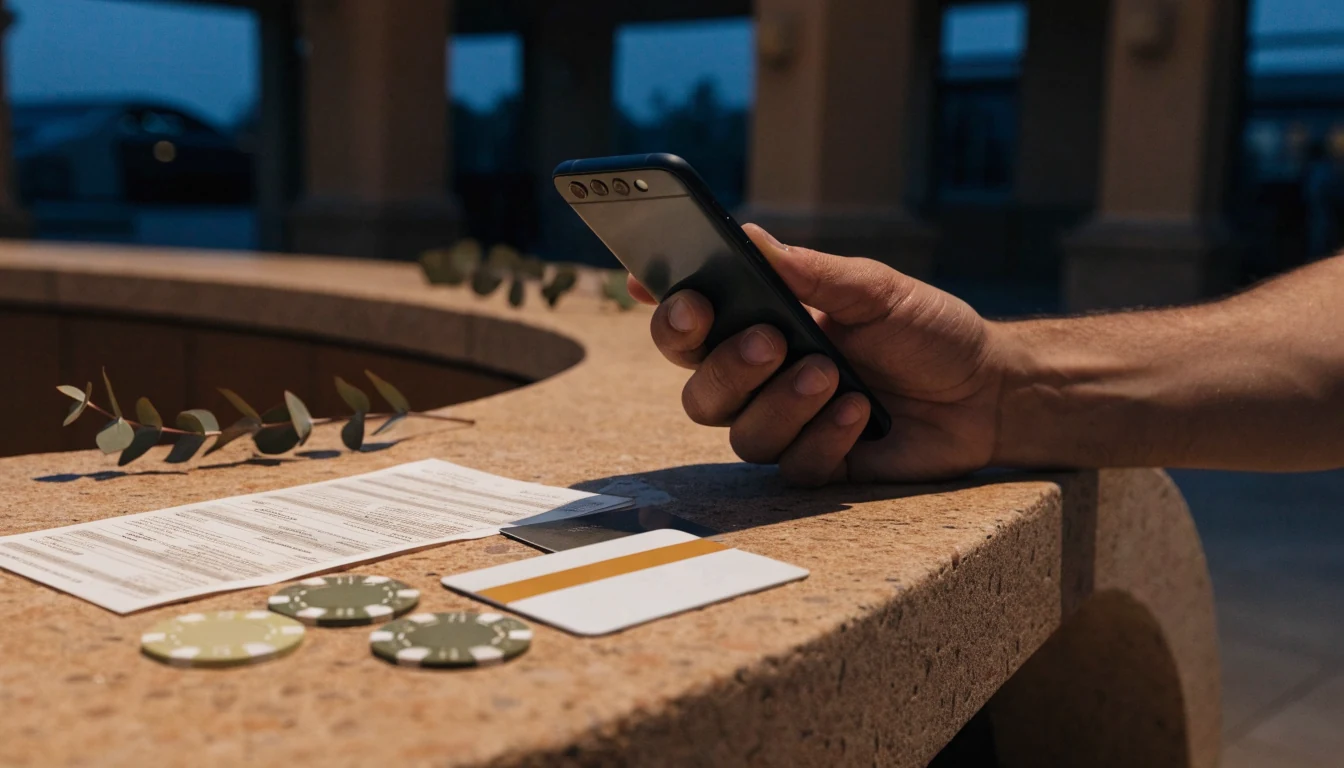
What “Pay by Phone” Means for an Australian Casino Payment
“Pay by phone” can describe two different things. One is a payment charged to your mobile-phone bill or prepaid balance. The other is a bank payment that you approve using your phone. They are not the same method, even though both involve a mobile device.
A phone-bill payment, sometimes called carrier billing, puts a charge on a telephone account rather than sending money directly from a bank account. The description “pay by phone” alone does not establish that a site accepts this kind of charge, or explain how it would be processed. Check what the payment method actually is before sharing account details or authorising a transaction. Do not assume that a casino deposit can be added to your phone bill simply because a page uses phone-related wording.
PayID is different. It is a payment service provided through Australia’s New Payments Platform (NPP). Instead of entering conventional bank-account details, a sender can use an identifier such as a mobile number or email address. The mobile number identifies the PayID; it does not mean the payment is billed by a phone company. The funds move through the banking system, and PayID transactions settle in real time through the NPP.
Operators offering no-deposit bonuses
Choosing a casino payment option means checking more than whether you can make a deposit from your phone. Use this list to review the available licensing, payout and minimum-deposit details before deciding what suits you.
-
Ricky Casino
- Payout speed
- crypto under 1 hour, PayID 1-3 business days
- Min. deposit
- A$20 (A$30 to qualify for the bonus)
You can deposit from A$20, or A$30 to qualify for the bonus. The listed payout times are under an hour for crypto and 1–3 business days for PayID.
-
SpinsUp
- License
- Curacao Gaming Control Board OGL/2023/174/0082 (Dama N.V.)
You can note its stated Curaçao Gaming Control Board licence, OGL/2023/174/0082, and operator Dama N.V. when reviewing this casino.
-
Kingmaker
- Payout speed
- crypto ~90 minutes, fiat 1-5 days
- Min. deposit
- A$30
The minimum deposit is A$30. Listed payouts take about 90 minutes for crypto and 1–5 days for fiat.
-
Playfina Casino
- License
- Curacao eGaming (Hollycorn N.V., since 2017)
- Min. deposit
- A$20-30 (depends on the offer)
You can check its Curaçao eGaming licensing details: Hollycorn N.V. has held the licence since 2017. The minimum deposit is A$20–30, depending on the offer.
-
WinSpirit Casino
- License
- Curacao eGaming OGL/2024/923/0383 (Antillephone N.V.)
- Min. deposit
- A$30
You can review its Curaçao eGaming licence, OGL/2024/923/0383, issued to Antillephone N.V. The minimum deposit is A$30.
-
Bizzo Casino
- License
- Curacao Gaming Control Board (TechSolutions Group N.V.)
You can note that Bizzo Casino is listed as licensed by the Curaçao Gaming Control Board, with TechSolutions Group N.V. as operator.
-
Wild Tokyo
- License
- Curacao
- Payout speed
- crypto 30-60 minutes, fiat 1-5 days
- Min. deposit
- A$10
You can deposit from A$10. The listed payout times are 30–60 minutes for crypto and 1–5 days for fiat.
-
7Bit Casino
- License
- Curacao, operated by Dama N.V.
You can note its Curaçao licence and that it is operated by Dama N.V. These are the available details for assessing this casino.
-
Lucky Dreams
- License
- Curacao
- Min. deposit
- A$20 (POLi)
You can deposit from A$20 using POLi. This makes the listed payment detail relevant if you are checking deposit options.
-
SkyCrown
- License
- Tobique Gaming Commission
- Payout speed
- crypto ~10-15 minutes, fiat 1-5 days
- Min. deposit
- A$30
You can review its Tobique Gaming Commission licence. The minimum deposit is A$30, and listed payout times are about 10–15 minutes for crypto and 1–5 days for fiat.
This distinction matters when you see phrases such as “casino pay by phone” or “pay by phone casino.” They might refer to a phone-bill charge, or they may simply mean that you can use your phone to access a banking app and approve a PayID payment. The wording is not enough to tell you which one is meant. Look for the named payment service and an explanation of where the money comes from before making any decision.
There is also an important Australian legal context. Under the Interactive Gambling Act 2001, it is illegal for operators to provide real-money online casino games—including pokies and table games—to people physically located in Australia. Advertising these services to Australian audiences is also prohibited. A payment label does not change the status of the service it is connected to, and this explanation is not a recommendation to use an online casino.
The useful question is therefore not whether a phone appears somewhere in the process, but what role it plays. If money is charged to a telephone account, that is phone-bill billing. If a banking app asks you to approve a transfer addressed through PayID, the phone is being used to access banking; the payment itself is a bank transfer through the NPP. Treating those as interchangeable can leave you unclear about the recipient, the source of funds, or what you are authorising.

When you encounter claims about pay-by-phone casinos in Australia, read the payment description rather than relying on the label. Confirm whether it names PayID or another method, and whether it describes a telephone-account charge or a bank payment. If the explanation is vague, do not infer that phone-bill deposits are supported. Understanding the terms can prevent confusion, but it does not make the provision of real-money online casino services to people in Australia lawful.
Using Your Mobile to Make a Casino Deposit
A mobile phone can be used to make a PayID payment through a banking app. That does not make a real-money online casino service lawful in Australia: the Interactive Gambling Act 2001 prohibits operators from providing online casino games to people physically in the country. This section is therefore not an instruction to fund an online casino account.
For general payment awareness, a PayID transaction is initiated in your bank’s app. The payer selects PayID, enters the requested amount and confirms the payment through the bank. In a transaction to a service that may lawfully accept it, the recipient details and any payment reference matter: an incorrect or incomplete reference can prevent the recipient from matching the payment promptly.
In casino-payment descriptions, a provider may ask for a player ID or username in the PayID reference so it can associate an incoming transfer with an account. If that detail is absent, the payment may not be credited automatically and could need manual handling by support. That possibility is one reason a payment reference should never be treated as an optional note. Do not send money to an online casino in Australia on the assumption that a bank transfer or mobile approval makes the underlying service permissible.
Attention: A missing or incorrect payment reference can prevent a deposit from being credited automatically and may require manual handling by support.
PayID casino deposits have been described as arriving within seconds, commonly in a few seconds to around fifteen seconds. That timing concerns the payment reaching the recipient; it does not establish that a service is lawful, or that an account will be credited at the same moment. Payment processing and account crediting are separate events, and a missing reference can interrupt the latter.
The phrase “pay by phone” can also mean charging a purchase to a mobile phone bill. That is different from approving a bank payment on a phone. A mobile banking app does not turn a payment into a phone-bill charge, and using a phone to access casino-style games does not change the legal status of an online casino service in Australia.
If you are reviewing a PayID request for any lawful payment, pause before confirming it. Check that the recipient shown in your banking app matches the intended recipient, and enter only the reference information supplied through a trustworthy channel. A payment sent with a wrong recipient or reference may take extra effort to trace. Never rely on a generic payment screen or an informal message as proof that the recipient is entitled to offer a service.
For Australians searching for a mobile casino payment, the important distinction is not whether a transaction can be approved on a phone. It is whether the service receiving the money may legally be provided to people in Australia. Real-money online casino games, including pokies, are prohibited interactive gambling services when offered to customers here. A PayID transfer is simply a payment mechanism; it does not authorise an operator to provide a prohibited service.

Deposit Limits, Minimums and Pending Payments
A deposit amount can be constrained by two separate figures: the limit imposed by your bank and the minimum stated by a payment service or gambling operator. They are not interchangeable. A bank may allow a transfer of a particular size while a site sets a higher minimum, or the bank may block a payment before the site’s own limit becomes relevant.
There is an important legal context in Australia: the Interactive Gambling Act 2001 prohibits operators from providing real-money online casino games to people located in the country. Information about payment limits should not be taken as an invitation or recommendation to deposit with a site offering those services.
Bank limits and deposit minimums
PayID limits are set by the bank connected to your account, not by a single Australia-wide rule. They differ between banks and may apply to each transaction as well as to the total sent during a day. Among major Australian banks, transaction limits are reported in the AUD 1,000–5,000 range, while daily limits are reported between AUD 10,000 and AUD 20,000. Your own bank’s settings are the relevant ones; those ranges do not guarantee that a particular transfer will be approved.
Among major Australian banks, transaction limits are reported in the AUD 1,000–5,000 range, while daily limits are reported between AUD 10,000 and AUD 20,000.
A bank’s maximum is also not a sensible target for a payment. It simply describes a possible ceiling, subject to the bank’s controls. Before relying on a figure, check your bank’s current PayID terms and any limit shown in your account. A limit can be lower than the ranges above, and a payment may be declined if it exceeds the limit applicable to you.
At the other end, PayID casino deposit minimums commonly fall around AUD 10–20. Some operators set a lower threshold for bank transfers, with deposits as low as AUD 5 reported for that method. Minimums are determined by the receiving operator and payment route; they are not bank rules and should not be assumed to apply across all sites. A payment below a stated minimum may fail to credit as expected, so an advertised minimum is not proof that an operator is lawful or appropriate for someone in Australia.
Why a payment may remain pending
A payment can leave your bank successfully without being matched to a player account automatically. Some casino payment systems rely on a player ID or username in the payment reference. If the required identifier is absent or entered incorrectly, the receiving operator may not be able to connect the funds to the intended account. The deposit can then remain pending while support staff investigate and process it manually.
This is a matching problem, not necessarily evidence that the bank transfer failed. Avoid sending another payment simply because the account balance has not changed: a second transfer may create a separate transaction to resolve. Keep the bank’s confirmation and transaction details, and contact the payment provider or operator through its official support channel to ask how an unmatched payment is handled. Do not share banking passwords or one-time security codes during that process.
If a site gives you a reference format, treat it as a required part of the payment record rather than an optional note. A missing or mistyped identifier can make a payment harder to allocate, even when the amount is within both the bank’s limit and the site’s minimum and maximum. A correct reference may help automatic matching, but it cannot guarantee that an operator will credit a payment promptly.
Read limits as separate conditions
Before making any financial decision, distinguish the bank’s transfer cap from the site’s own deposit rules. The bank controls what it will permit from your account; the operator sets the amount it will accept and the information it needs to identify a payment. Neither figure resolves the legal position of an online casino service offered to people in Australia.
If funds have already been sent and are not showing in an account, retain the transaction record and seek clarification rather than repeating the payment. Where the required player reference is missing, manual processing may be necessary, and the time involved depends on the operator’s handling of the case. No bank limit or stated minimum can tell you how quickly that review will be completed.
Do
- Retain the transaction record
- Seek clarification through official support
- Use the required reference format
Don't
- Repeat the payment immediately
- Share banking passwords or security codes
- Treat the reference as an optional note
Paying by Phone Is Not the Same as Paying by Credit
“Paying by phone” can mean very different things. A phone may simply be the device you use to approve a payment in your banking app. That does not make the payment a charge to your mobile bill, and it does not make it a credit-card transaction. A phone-bill service, by contrast, adds a charge to your telecommunications account; its availability should not be assumed from the fact that a payment can be approved on a phone.
This distinction matters in Australia. The Interactive Gambling Act 2001 prohibits operators from providing real-money online casino games to people located in the country. A payment method does not change that restriction. Credit cards must not be used to pay for online gambling services, and a card option shown by a service does not make the underlying casino activity lawful.
Debit and credit cards are also not interchangeable. A specialist review describes Visa and Mastercard as widely accepted for deposits, but that is not a basis for treating credit-card deposits as permitted for Australian online gambling. Check what type of card a payment would charge, and do not proceed with a credit-card payment for this purpose.
Withdrawals can work differently from deposits. The same specialist review notes that card withdrawals may be slower or unavailable, depending on the payment processor. It also describes operators as sometimes requiring a withdrawal to return by the deposit method, where that is possible. These are processor or operator conditions, not a guarantee that a card can receive a payout. Before relying on a card route, read the stated withdrawal options and restrictions.
Searches for phone-bill casinos, including services associated with Boku, can blur the line between a mobile charge and a phone used to approve a bank transfer. The label alone tells you neither how the payment is funded nor whether it is suitable for a particular transaction. For Australian readers, the essential point is not to treat phone approval, a phone-bill charge and credit-card payment as equivalent—or as a way around the law.
Check Safety and Account Requirements Before You Pay
A payment option does not establish that an online casino is lawful or safe to use in Australia. Under the Interactive Gambling Act 2001, operators cannot provide real-money online casino games to people located in Australia. A service being described as “not on BetStop” does not change that position or amount to an endorsement. Nor does a phone-bill payment option, whether or not it uses Boku, prove that a site has been checked or approved.
Before confirming any payment, check the recipient name shown in your banking app against the details the service supplied. Stop if the name differs or the recipient is unclear; do not assume a familiar-looking payment screen means the money is going to the intended business. For PayID, follow the payment instructions carefully and include the required player ID or username in the reference. Check the reference again before sending. A missing or incorrect reference can prevent automatic crediting and leave a deposit awaiting manual support handling.
Legal Risk
Under the Interactive Gambling Act 2001, it is illegal for operators to provide real-money online casino games to people physically located in Australia.
Treat requests for personal or financial information with care. Use only the payment instructions provided through the account interface, and do not send identity documents through an unsolicited message. If a request seems inconsistent with the account process, pause and seek clarification through the service’s stated support channel.
KYC verification can be required before a first withdrawal. A specialist review notes that completing identity checks early may help prevent paperwork from holding up a payout. Check what documents are requested and that the details on your account match them. Do not submit documents if you cannot establish who will receive them or how they will be handled.
A delay after requesting a withdrawal does not necessarily mean the payment network has failed. A specialist review identifies internal withdrawal checks as a possible source of delay; for PayID, the operator’s processing can be the bottleneck rather than the payment rail. Keep the request confirmation and any relevant transaction details, then ask support whether the withdrawal is still under review or whether further information is needed. Avoid making another payment simply to try to release a withdrawal.
These checks cannot make a prohibited service lawful, and a payment method cannot verify an operator’s standing. If you are considering real-money casino play from Australia, take the legal restriction into account before sending money or personal documents.
Bonus Terms to Read Before Accepting an Offer
A bonus can change what you need to do before any related winnings become available. Before you accept, read the full terms attached to the offer—not just the headline or the amount shown beside it. The details that matter most are wagering requirements, maximum bet limits, game weighting, time limits and any cap on cashing out.
Check the wagering requirement
Look for whether you must wager the bonus, your deposit, or both, and how the requirement is calculated. A requirement tied to the deposit as well as the bonus can mean more play is needed than the headline suggests. Check which balance counts towards the requirement and whether it must be completed before you can withdraw.
Do not assume that every eligible wager contributes equally. The terms should explain how different games count. If that information is unclear, ask the operator for an explanation before accepting; once an offer is active, its conditions may affect how you can use the balance.
Find the maximum bet
Bonus rules may limit the amount you can stake while the offer is active. Check both the stated maximum and when it applies: the restriction might cover play while wagering requirements remain unfinished. A bet above the permitted limit could affect eligibility for the bonus or related winnings, depending on the terms.
If you do not understand whether the limit applies per round, spin or hand, do not guess. Get clarification before you play. The displayed balance alone may not show whether a particular stake complies with the offer conditions.
Understanding Maximum Bets
Bonus rules may limit the amount you can stake while an offer is active. Exceeding the permitted limit could affect your eligibility for the bonus or related winnings.
Read the game weighting
Some offers count only certain games, or count them at different rates, towards wagering. A game that contributes less may take more play to meet the stated requirement than one that counts fully. Check the eligible-game list and the weighting for each category, rather than assuming that all pokies or other casino games qualify in the same way.
This is particularly important if you intend to use an offer while playing a specific game. Confirm that the game is included and how its contribution is calculated. A game being available on the site does not establish that it helps complete the bonus rules.
Note the time limit and cash-out cap
Check when the offer period begins and when the requirement must be completed. If the terms set a deadline, work out whether you can meet it without rushing or spending more than planned. Also look for a maximum cash-out condition: a cap can limit the amount withdrawable from bonus play even after other requirements have been met.
Read the conditions as a set. A short time limit, restricted game weighting and a maximum bet rule can all affect the same offer. Keep a copy of the terms you accepted so you can refer to the exact wording if the balance or withdrawal eligibility is later questioned.
If a condition is missing, contradictory or difficult to interpret, pause before accepting. A bonus is optional; you can decide whether its restrictions suit you without treating the advertised value as money already available to withdraw.
Free Spins and Credit-Related Offers: Check the Conditions
A free-spins offer can sound simple: a set of spins is provided without a separate payment for each one. But the label alone does not tell you what happens to any winnings, which games qualify, or whether you must meet other conditions before making a withdrawal. Read the full terms before accepting, rather than relying on the offer headline.
Pay-by-phone wording can also blur two different ideas. A mobile phone may be used to approve a bank payment, while a credit-related promotion may refer to a bonus or a payment option. Neither phrase confirms that a phone-bill charge is available, or that a credit card can be used for online gambling. Check what the offer actually requires and how it is funded.
For free spins, look for the eligible game, when the spins expire, any maximum bet while using related bonus funds, and any cash-out cap. Check whether winnings carry wagering requirements or are subject to different rules from the spins themselves. If those details are unclear, do not accept the offer until the operator explains them in writing.
A promotion described as “credit” also needs careful reading: establish whether it is bonus credit, a deposit match, or another offer, and identify any deposit requirement and withdrawal conditions. Do not assume the word means borrowed money or that the credit can be withdrawn immediately.
The practical point is simple: accept only when you understand the conditions attached to both the offer and any resulting balance. If the terms are missing, inconsistent, or difficult to locate, leaving the promotion unaccepted avoids being bound by rules you have not reviewed.
No-Wagering Offers: Do Not Assume the Terms
“No wagering” sounds straightforward, but the label does not tell you everything about an offer. It may indicate that a wagering requirement does not apply, yet other conditions can still affect whether a bonus or any associated winnings can be kept or withdrawn. Read the full terms rather than relying on a headline, a banner or a description attached to a mobile payment option.
Check the maximum bet allowed while an offer is active. A term may limit how much you can stake, and exceeding that limit may affect eligibility or a later cash-out. The relevant amount and consequences should be stated in the offer conditions. If they are unclear, do not assume that the offer has no restrictions simply because it is described as wagering-free.
Look for a time limit as well. The terms may set a period for claiming an offer, using it or meeting other conditions. Confirm when that period begins and what happens if it expires. A claim such as “no wagering” does not, by itself, mean there is no deadline.
Game weighting is another point to check where it applies. Conditions may distinguish between eligible games or assign different contributions towards an offer’s requirements. Do not assume that every game qualifies equally—or that all games qualify at all. The offer should explain which rules apply.
Read any maximum cash-out condition before accepting. A no-wagering label does not establish that winnings can be withdrawn without a cap or further checks. Find out whether a limit applies, which balance it covers and what happens to any amount above it. If the terms do not make this clear, treat the offer as uncertain rather than filling in the gaps yourself.
These checks apply whether an offer is described as a no-deposit bonus, linked to a phone payment or promoted alongside a mobile casino service. A payment method does not determine the bonus rules. Searching for a phone-based casino offer, or for a service associated with Boku or another billing method, is not a substitute for reading the conditions attached to that particular offer. Nor does a Dutch-market label establish that the offer is available or lawful for someone in Australia.
There is also a separate legal issue: under Australia’s Interactive Gambling Act 2001, operators must not provide real-money online casino games to people physically in Australia. A “no wagering” description does not change that position. Be cautious about any promotion suggesting that a bonus label or payment route makes a service suitable for Australian use.
Before accepting any offer, make sure you understand the maximum bet, applicable time limit, game weighting and cash-out rules. If any condition is missing or ambiguous, do not rely on the promotional wording to resolve it.
Casino Games and Payment Methods Are Separate Questions
A payment option describes how money is sent; it does not tell you what games a website provides or whether those games may lawfully be offered to someone in Australia. A site might describe a deposit as mobile-friendly or display a familiar payment brand, but that wording says nothing about the legality of its gambling services.
A payment method describes how money is sent; it does not establish the legality of the gambling services or the specific games provided.
This distinction matters because real-money online casino services are prohibited for operators serving people physically in Australia under the Interactive Gambling Act 2001. The restriction covers casino-style interactive gambling, including pokies and other real-money casino games. Changing the payment route does not change the nature of the service. A phone-based bank approval, a card payment or another transfer method cannot make a prohibited offer lawful.
The reverse is also true: a payment method does not guarantee access to a particular game category. What a site lists and what it accepts for deposits are separate features, and neither should be treated as proof that the other is available. A promotion mentioning a deposit method does not establish that a bonus applies to every game, either. If an offer is presented, its conditions still need careful review; the payment label alone does not explain them.
Terms such as “pay by phone” can also blur these topics. They may refer to using a phone to approve a bank payment, rather than charging a deposit to a mobile bill. Neither interpretation tells you whether a site’s games are permitted in Australia. A polished payment page or a familiar-looking games menu should not be taken as evidence of local approval.
Country references require the same care. A site or advertisement aimed at Germany may describe a different market, but that does not determine what is allowed for a person in Australia. The relevant issue is where you are located and whether the service is being provided to someone there—not the language, branding or payment option shown on the page.

Keep these questions distinct: what a payment method does, what a website claims to offer, and whether that gambling service may be provided in Australia. A convenient-looking deposit route cannot answer the legal question or make an online casino offer suitable for Australian residents.
Online Casino Payments: Consider a Bank Transfer Backup
A bank transfer is a separate payment route, but it does not change the legal position of an online casino. Under Australia’s Interactive Gambling Act 2001, operators cannot provide real-money online casino games to people physically in Australia. Moving money by bank transfer rather than PayID does not make such a service lawful.
If an offshore casino asks you to send a bank transfer, pause before acting. Do not treat the presence of bank details or a payment option as proof that the service is authorised in Australia. A transfer may be difficult to resolve if it goes to the wrong recipient, and a bank payment can take time to appear.
For a bank wire in a lawful context, the sender needs the recipient’s business name, bank account number and bank name. International transfers may also require SWIFT, BIC or IBAN details. You can arrange a wire at a bank, by phone or through online banking on a computer or mobile device. Before confirming any transfer, check that the recipient details match the intended recipient; do not rely on an informal message or an unexplained change to account details.
Timing is another consideration. A bank wire may take as long as seven business days to show in an account. That makes it unsuitable when you need funds to arrive promptly. Charges may also apply, and they can be higher than for other non-banking transactions. If the accounts use different currencies, exchange fees may add to the cost.

A payment request connected with online casino play should not be treated as an ordinary bill simply because it arrives through a familiar bank channel. If you have already sent money and cannot resolve the issue with your bank, seek appropriate consumer or financial guidance. For gambling-related support in Australia, Gambling Help Online is available.
What are the minimum and maximum deposit limits at PayID casinos?
Minimum deposits commonly start at AUD 10–20, though some services accept AUD 5. The maximum depends on your bank: many major Australian banks allow AUD 1,000–5,000 per transaction, with daily limits of AUD 10,000–20,000.
How long do PayID deposits take?
The payment usually reaches the recipient within 3–15 seconds. Crediting an account may take longer if the required player ID or username is missing from the payment reference.
Can you withdraw casino winnings using PayID?
Some services offer PayID withdrawals, which may arrive within minutes to hours after approval. Internal reviews can delay payment, and identity checks are usually required before your first withdrawal.
Do Australian online casinos support PayID withdrawals?
Some services offer PayID withdrawals, but processing and approval times vary. Real-money online casino games are prohibited for operators to provide to people physically in Australia.
What is the minimum PayID deposit?
PayID deposits commonly start at AUD 10–20, and some services accept as little as AUD 5.